
How to buy clothes online without surprises: sizes, delivery and returns
Pick your size from a garment’s measurements, read the product page closely, and check delivery and returns before you order, so fewer surprises arrive with the parcel.

Published
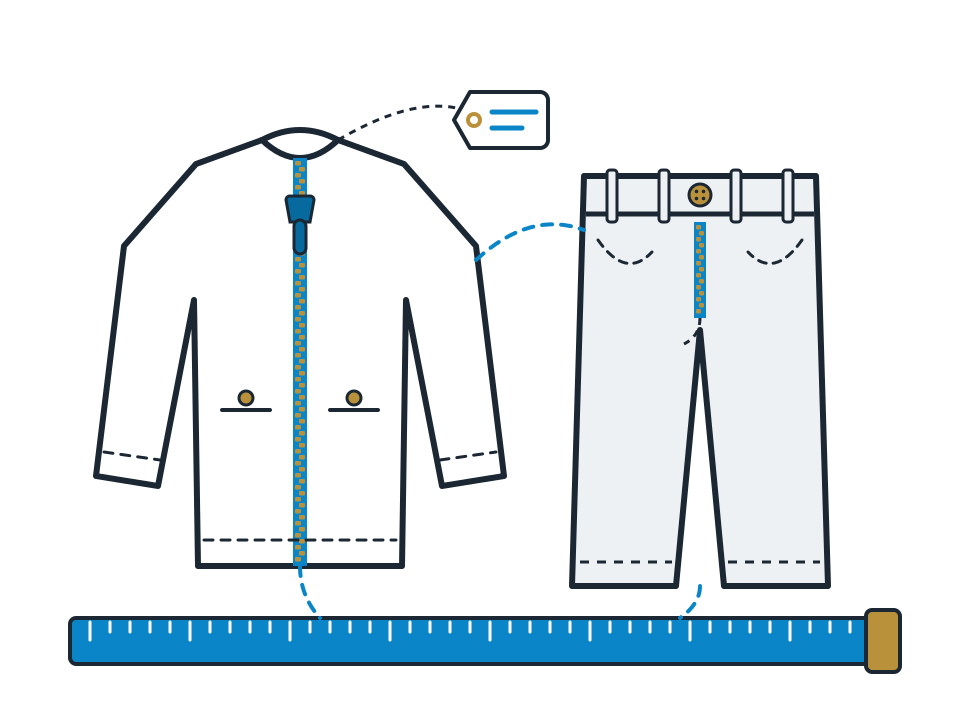
Ordering clothes online is a chain of small decisions, and a surprise at the door usually means that one link was skipped: the size came from the label instead of the measurements, a detail on the product page went unread, or the returns terms were not the ones you assumed. This guide follows the chain in the order you meet it, from choosing a size to deciding whether to keep what arrives, so that each check leads into the next one and none of them takes long.
Start from measurements, not from the size label
A size label such as M, 38 or 10 is a maker’s shorthand, and each maker draws up its own size chart. There is an international standard for labelling a size by the key measurements it is cut for, ISO 8559-2, revised in 2025, but many brands still publish their own charts, so the same letter or number can stand for quite different garments from one store to the next.
Two researchers showed how wide the gap can be in the 2024 proceedings of the International Textile and Apparel Association. They looked at 120 clothing brands, compared the women’s letter-size charts of the 84 that published one, and found that the measurements behind a single letter changed from brand to brand, with the smallest differences in the smallest sizes and much wider ones in the largest, such as the chest figures given for 2XL. A label tells you where a garment sits in one maker’s range, and the measurements tell you what the garment actually is.
The number on a label also depends on the numbering system. The same garment can carry one number on a European label, another on a British one and a third on an American one, which is why many retailers print a conversion table beside their size charts. Before you compare anything, it helps to know which kind of label you are looking at.
| Label | Looks like | What it tells you | What to check |
|---|---|---|---|
| Letter sizes | XS, S, M, L, XL, 2XL | A position in one maker’s range | That maker’s chart for that item |
| Number sizes | 36, 38, 40 or 8, 10, 12 | A position in a country’s or a maker’s numbering | Which system the store uses, and its conversion table |
| Measurement sizes | W32 L32 on jeans | Measurements, usually in inches or centimetres | Whether the numbers describe the garment itself or the size it was cut for |
| One size | One size, OS | A single cut, often with stretch, ties or a drawstring | The listed measurements and how much the fabric gives |
Measure a garment you already like
A dependable comparison needs nothing more than a tape measure and a garment you already own. Take a piece of the same kind that you wear often and like the way it sits, lay it flat, and measure it in straight lines: the chest width, for example, goes straight across from one underarm seam to the other. Measured flat, a garment gives numbers you can set beside the measurements a product chart lists for the item itself.
- Choose a garment of the same kind and a similar fabric: a knitted T-shirt to compare with a T-shirt, rigid denim to compare with rigid denim.
- Lay it on a table, close its fastenings (the zip, the buttons, the snaps) and smooth it out without pulling it.
- Measure in straight lines, in the unit the store uses, centimetres or inches.
- Write the numbers down with the garment’s name, so the next order starts from them.
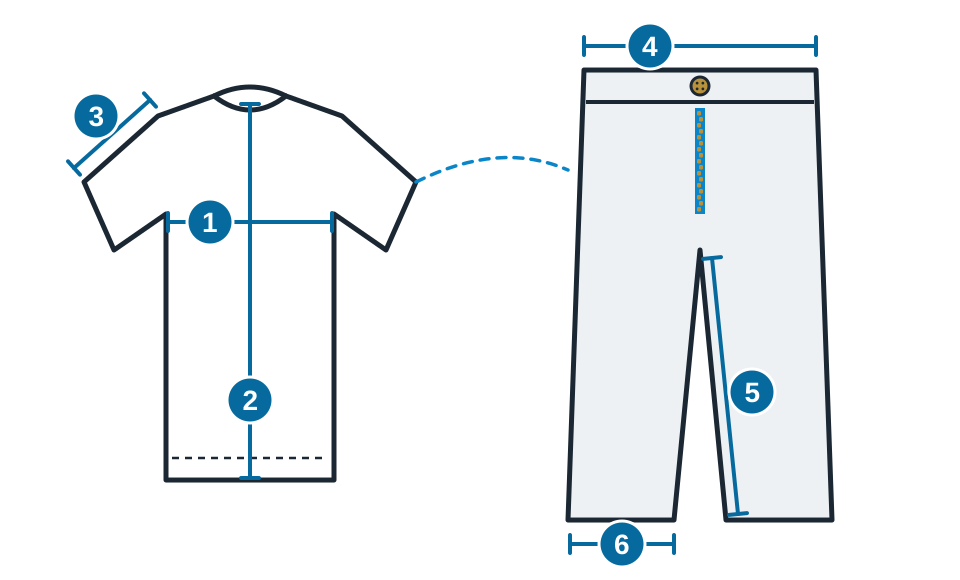
- Chest width: straight across, from one underarm seam to the other.
- Length: from the collar seam at the centre of the back down to the hem.
- Sleeve: from the shoulder seam to the end of the sleeve.
- Waist width: straight across the top edge, with the fastening closed.
- Inside leg: from the seam where the legs meet down to the hem.
- Leg opening: straight across the hem of one leg.
Compare your numbers with the product’s own chart
With your garment’s numbers in hand, you need the same numbers for the product. Size guides come in two kinds, and it is worth knowing which one you are reading. A product chart lists the garment’s own measurements, often under a heading such as “product measurements” or “garment measurements”. A general chart lists the measurements each size was cut for, so it describes the size rather than the item in front of you. Only the first kind can be laid beside your own garment’s numbers, so look for it on the product page, in a tab or a section about size and fit, before you rely on the general one.
Allow a little room in the comparison, because no two garments are cut and sewn exactly alike, and a measurement taken by hand on a soft fabric moves a little too. Treat a difference of a centimetre or two as a match, and a bigger difference as a reason to look at the next size up or down.
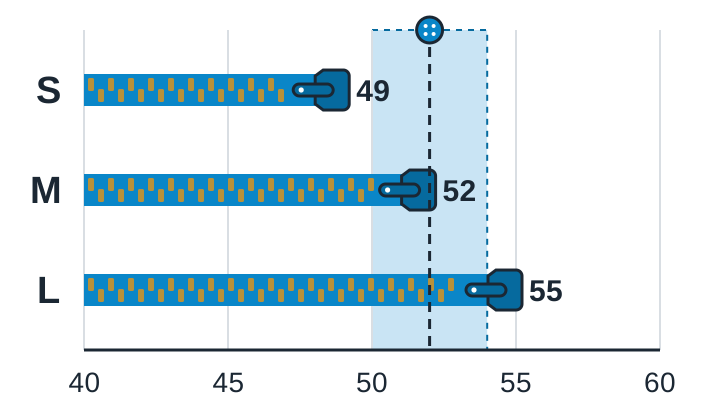
The fabric decides how a measurement feels once you wear it. Elastane, also sold as spandex, can stretch to several times its length and still recover almost completely, so a knit that lists it in its composition gives more than rigid denim or a woven shirt without it. Compare like with like: if your reference garment stretches and the new one does not, choose the size whose numbers are equal to yours or a little above them.
Read the whole product page, not just the photos
The photos show you the style, and the text tells you how the garment is made. Reading the page from top to bottom takes a minute and answers most of the questions that would otherwise arrive with the parcel.
- Composition: the fibres and their share, which tells you whether the garment stretches and how it is likely to behave in the wash.
- Cut or fit words: slim, regular, relaxed, oversized. Each store uses its own scale, so read them together with the measurements rather than on their own.
- Lengths: cropped or longline for tops, the inside leg for trousers, the sleeve length for shirts and jackets.
- Fastenings and lining: zips, buttons, snaps, and whether the garment is lined, which changes how it closes and how it sits.
- Care instructions: many pages repeat the care label, so you know before you order whether a piece needs hand washing or dry cleaning.
- Colour: screens show colours differently, so read the colour’s name and look at every photo, not only the first one.
- Reviews that mention size: comments such as “comes up small” are worth more when several reviewers say the same thing and name the size they ordered.
- Returnable or not: some product pages state that an item cannot be returned, and that line matters before the item goes into your basket.
Check delivery before you order
Delivery terms sit on the store’s delivery page and appear again at checkout, before you confirm the order. A few lines there tell you when the parcel is likely to arrive and how you will follow it.
- Dispatch and delivery times: an estimate such as “3 to 5 working days” may start only when the parcel leaves the warehouse, so add the preparation time the page gives.
- Where it ships from: an order sent from another continent takes longer, and a large order may arrive in several parcels.
- Delivery options: to your door, to a pickup point or a locker, or to a store, and whether someone has to be there to receive it.
- Tracking: whether you get a tracking number, and which carrier delivers the last part of the journey.
- The delivery charge: shown at checkout before you confirm; some stores deliver without a charge above a certain order value, and that value differs between countries.
Read the returns terms first
Returns are the link that decides what happens if the size or the style is not right after all, so they are worth reading before you order rather than after the parcel arrives. Look for six things on the returns page:
- The window: how many days you have.
- When the window starts: some stores count from the day the order ships, others from the day it is delivered.
- The condition: unworn, with every label still attached, often in the original packaging.
- The route: by post with a return label, at a drop-off point, or in one of the store’s shops, and whether a shop can take back an online order.
- The cost: free for every return, free only for the first one, or a fee taken off on some country sites.
- The exceptions: final-sale items, jewellery, and anything the product page marks as not returnable.
| Retailer page | Window | Counted from | What the page says about cost and condition |
|---|---|---|---|
| Zara, help centre (United States site) | 30 days | The day the order ships | Items in their original condition with all their labels, returned in the same country; returning in a Zara shop is free, while a return through a drop-off point has a fee |
| Shein, return policy (United States site) | 30 days for most items | The day the order is delivered | Items new and unworn with their original tags; the first return from an order is free and later returns from the same order have a fee; jewellery, clearance and other final-sale items cannot be returned |
These two pages show how much the details move: the same 30 days can start on different days, and “free returns” can mean every return or only the first. Terms also change over time and between a retailer’s country sites, so read the page for the country you are ordering in on the day you order.
When the parcel arrives
Open the parcel soon, while most of the return window is still ahead of you, and keep the labels on until you have decided. Lay each new piece flat beside the garment you measured: if the numbers match and it closes, hangs and moves the way you expected, the chain has held. If something goes back, follow the store’s own returns route, keep the proof of posting or the drop-off receipt, and note the date, so you can follow the return as easily as you followed the delivery.
Questions readers ask
What if the size guide only lists the measurements each size was cut for?
Look further down the product page, or in a separate tab, for the garment’s own measurements. If there are none, the store’s customer service can often give them for a particular item. Without them, the next best reference is a garment of the same kind from the same store that you already own, because a maker usually keeps its sizing consistent within one line.
What if my garment falls between two sizes?
Start from the measurement that matters most for that garment: the chest width for a top, the waist width and the inside leg for trousers. Then look at the fabric and the cut. A relaxed or oversized cut already adds room, which points to the smaller size, while a rigid fabric with a slim cut points to the larger one.
Does “free returns” mean every return is free?
Not always. Some stores make only the first return from an order free, others make returns free only in their shops, and the terms can differ between countries. The returns page, and often the order confirmation, say which applies to your order.
Can I return an online order in a shop?
Many retailers with shops accept it, as Zara’s help pages describe, but not every store does, and it usually has to be a shop in the same country as the site you ordered from. Check the returns page before you take the parcel in.
Your order, link by link
- Measure a garment you already like, laid flat.
- Find the product’s own measurements and compare them with yours, allowing a centimetre or two.
- Read the composition, the cut and the details on the product page.
- Check the delivery time, the options and the tracking.
- Read the returns window, the day it starts, the condition and the cost.
- Order, try the piece on soon, and keep its labels until you decide.
Measurements choose the size, the product page confirms it, and the returns terms tell you what happens if the two still disagree.
Sources
- Wenjia Zong and Fatma Baytar, “Women’s Alpha Size Charts Comparison Among 120 Clothing Brands”, International Textile and Apparel Association (ITAA) Proceedings, vol. 80, 2024: iastatedigitalpress.com
- ISO 8559-2:2025, Size designation of clothes, Part 2: primary and secondary dimension indicators: iso.org
- Zara, help centre, “How to return” (United States site, seen on 13 November 2026): zara.com
- Shein, return policy (United States site, seen on 13 November 2026): shein.com
- Museum of Fine Arts, Boston, CAMEO materials database, “Spandex fiber”: cameo.mfa.org